
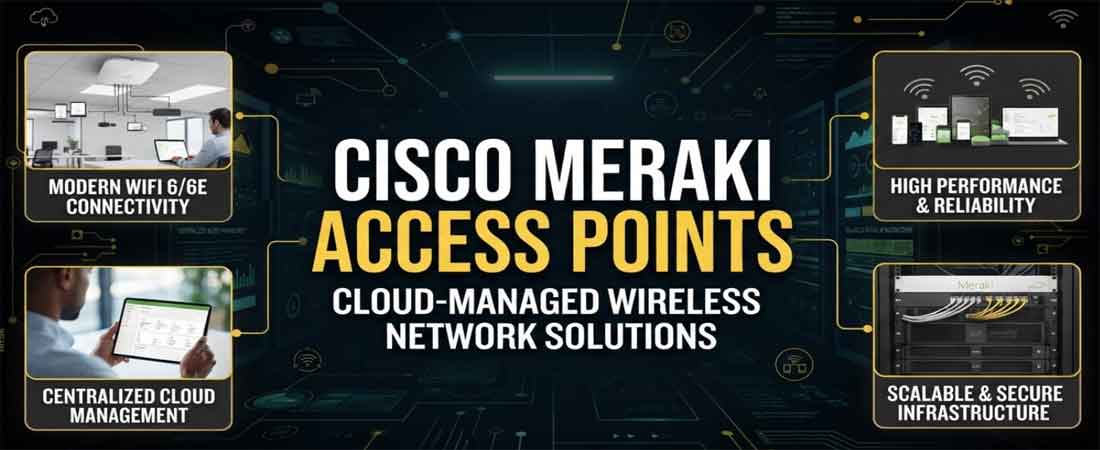
Cisco Meraki Access Points in Delhi, NCR and India
Traditional enterprise wireless came with a hidden cost that rarely appeared on the quotation — the controller. A physical appliance sitting in the server room, needing its own licensing, firmware cycle, redundancy plan and specialist knowledge to operate. Cisco Meraki removed that entirely. Dream-N-Drive supplies genuine Cisco Meraki access points India businesses deploy when they want enterprise wireless without enterprise complexity, across Delhi NCR and nationwide.
The proposition is straightforward. Every access point connects back to a browser-based cloud platform, and everything — configuration, monitoring, firmware, troubleshooting, reporting — happens there. A branch office in Ghaziabad and a head office in Gurgaon appear on the same screen, managed by the same person, with no equipment in either location beyond the access points themselves. For organisations without a large in-house network team, that shift changes what is realistically manageable.
As an experienced Meraki access point reseller Delhi businesses work with, we supply the complete current range — Wi-Fi 7 CW series, Wi-Fi 6E models, and the established MR series — together with correct dashboard licensing, deployment and ongoing AMC support. This page walks through what Meraki actually is, how its licensing genuinely works, every current model, and how to choose sensibly between them.
What Makes Cloud-Managed Meraki Wireless Different
Most wireless vendors now offer some form of cloud management, usually added on top of an architecture originally built around controllers. Meraki was designed cloud-first from the beginning, and the difference shows in daily operation rather than on a specification sheet.
A new access point ships directly to any site, gets plugged into a PoE port, and pulls its full configuration from the cloud automatically. Nobody needs to travel, no console cable is required, and no local staff need networking knowledge. Firmware updates are scheduled centrally and applied across every site in a maintenance window you define. When a user reports a problem, the dashboard shows that specific client's connection history, signal strength, and which access point they were attached to at the time — rather than leaving an engineer to reconstruct events from logs.
The trade-off is real and worth stating plainly. Meraki gives less granular command-line control than traditional enterprise platforms, and the hardware is dependent on active licensing. In exchange, a cloud managed WiFi India deployment becomes something a competent generalist can run confidently, which for most businesses is the more valuable outcome.
The Meraki Dashboard — Managing Every Site From One Screen
The Meraki Dashboard is where a Meraki network genuinely lives. It is a browser platform requiring no software installation, no VPN into the office, and no server to maintain. Log in from anywhere and every access point across every location is visible at once.
Practically, this means an IT manager sitting in Nehru Place can add a guest SSID to eleven retail outlets simultaneously, push a firmware update to a warehouse in Faridabad at two in the morning, or check why the third-floor conference room in Noida had poor video quality yesterday afternoon. The platform records client history, so investigation happens after the fact rather than requiring someone to be present while the problem occurs.
Built-in capability extends past basic management. Location analytics show visitor footfall and dwell time, useful for retail and hospitality. Application visibility reveals what bandwidth is actually being consumed. Air Marshal continuously scans for rogue access points attempting to impersonate your network. Alerts can be routed to email or SMS when an access point goes offline, so problems surface before users start calling.
Understanding Meraki Licensing Before You Buy
This is the single most misunderstood aspect of Meraki, and getting it wrong is expensive. Every Meraki access point requires an active dashboard licence to function. This is not an optional support contract or an add-on feature bundle — it is what makes the hardware operate at all.
Licences are purchased per device, in terms of one, three, five, seven or ten years. Longer terms carry meaningfully lower per-year pricing, which is why buying a three or five year licence alongside the hardware usually costs less overall than annual renewals. When a licence approaches expiry, the dashboard issues escalating warnings across a grace period. If that window closes without renewal, the access points stop serving clients — the wireless network simply goes down.
Two situations catch businesses out repeatedly. First, buying discounted hardware from an unofficial source only to discover licensing must be purchased separately at full cost, erasing the saving. Second, losing track of expiry dates across a fleet purchased at different times. Dream-N-Drive quotes hardware and Meraki licence India together as one clear figure, and tracks every renewal date on your behalf so coverage never lapses unnoticed.
Complete Range of Cisco Meraki Access Point Models
Meraki's naming has evolved. Established models carry the familiar MR prefix, while newer hardware uses the unified CW Cisco Wireless naming. Both are managed identically through the same dashboard and mix freely within one network. Below is the current Meraki access point models India range that Dream-N-Drive supplies, grouped by wireless generation and deployment type.
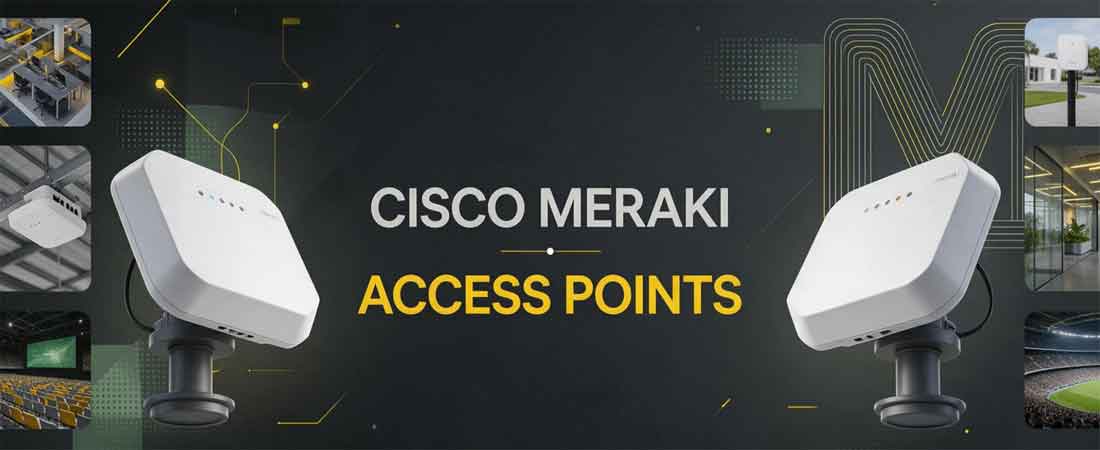
Meraki CW9178I — Wi-Fi 7 Flagship
The top of the current Meraki wireless range, delivering tri-band Wi-Fi 7 with aggregate frame rates reaching around 24 Gbps across 2.4 GHz, 5 GHz and 6 GHz radios simultaneously. Built for stadium-class density, large auditoriums and campus cores. Managed entirely through the Meraki Dashboard alongside every other model.
Meraki CW9176I & CW9176D1
High-performance Wi-Fi 7 access points for demanding indoor environments. The CW9176I uses omnidirectional internal antennas for standard ceiling mounting, while the CW9176D1 provides an integrated directional patch antenna for focused coverage in corridors, lecture halls and warehouse aisles requiring shaped rather than circular reach.
Meraki CW9174 — Wi-Fi 7 Branch
A compact Wi-Fi 7 access point aimed at branch offices, small sites and distributed retail locations. It brings 6 GHz operation and modern throughput into deployments that do not need flagship capacity, and represents a natural upgrade path for sites currently running MR44 or MR46 hardware.
Meraki CW9172I & CW9172H
The entry point into Meraki Wi-Fi 7. The CW9172I is a standard ceiling-mount indoor unit, while the CW9172H is a wall-plate model with wired passthrough ports designed for hotel rooms, hostels and student accommodation where in-room connectivity is needed without visible ceiling hardware.
Meraki CW9166I & CW9166D1
Flagship Wi-Fi 6E access points opening the 6 GHz band for high-density indoor environments. The CW9166I covers standard omnidirectional deployment and the CW9166D1 adds directional patch antennas. Both remain strong choices where Wi-Fi 6E client devices dominate and Wi-Fi 7 is not yet required.
Meraki CW9164I — Wi-Fi 6E
A mid-range tri-band Wi-Fi 6E access point balancing capacity against cost for corporate floors, educational buildings and mid-sized offices. It delivers 6 GHz relief for congested environments without the price of flagship hardware, and integrates seamlessly with existing MR series deployments on the same dashboard.
Meraki CW9162I — Wi-Fi 6E Entry
The most accessible Wi-Fi 6E model in the range, suited to smaller offices, clinics and retail floors adopting 6 GHz capability on a controlled budget. Compact enough for discreet ceiling installation while still delivering genuine tri-band operation and full dashboard management features.
Meraki CW9163E — Wi-Fi 6E Outdoor
Weather-rated Wi-Fi 6E built for external deployment across campus grounds, courtyards, loading bays and covered parking. Supports external antenna options for directional coverage or extended reach, with sealing and temperature tolerance suited to Indian summer heat and monsoon exposure.
Meraki MR57 — Wi-Fi 6E
A high-capacity tri-band Wi-Fi 6E access point from the established MR line, widely deployed across enterprise campuses and conference environments. Frequently chosen by organisations already standardised on MR naming and inventory who want 6 GHz capability without moving to CW hardware.
Meraki MR56 & MR46 & MR46E
High-performance Wi-Fi 6 access points, with the MR56 reaching around 5.38 Gbps combined throughput for dense environments. The MR46E variant accepts external antennas for warehouses and irregular spaces where standard internal antennas cannot deliver the required coverage pattern.
Meraki MR44 & MR36 & MR36H
The volume Wi-Fi 6 models across corporate offices in India. The MR44 delivers around 3 Gbps for busier floors, the MR36 covers standard office density economically, and the MR36H is a wall-plate unit with passthrough ports for hospitality and accommodation deployments.
Meraki MR28 — Wi-Fi 6 Essential
An entry-level Wi-Fi 6 access point reaching around 1.5 Gbps, sized for small offices, branch counters, clinics and cafes. It provides genuine enterprise dashboard management and security at the lowest hardware cost in the current Meraki wireless lineup.
Meraki MR86 — Outdoor Flagship
An IP67-rated outdoor Wi-Fi 6 access point engineered for demanding external environments including warehouse yards, industrial premises and open campus areas. Supports external antennas for directional or long-range coverage, with sealing and surge protection appropriate to exposed Indian installations.
Meraki MR76 & MR78 — Outdoor
Ruggedised Wi-Fi 6 outdoor access points for courtyards, terraces, parking areas and semi-exposed spaces. Both carry IP67 protection with external antenna support, and are commonly deployed to extend indoor coverage outward across hotel grounds, school campuses and manufacturing sites.
Meraki Dashboard Licensing
Available in one, three, five, seven and ten year terms, purchased per access point. Longer terms reduce annual cost significantly. Licensing covers full dashboard access, firmware updates, analytics and support, and applies uniformly across every MR and CW model in the current range.
Wi-Fi 7, Wi-Fi 6E or Wi-Fi 6 — Which Generation Do You Need
Newer is not automatically better value. Wireless generations only deliver their advantage when client devices can actually use them, and most Indian offices still run a mixed estate of laptops and phones spanning several years.
| Generation | Best Suited To | Typical Meraki Models |
|---|---|---|
| Wi-Fi 7 | New builds and refreshes planned to last five to seven years, high-density venues, organisations with current-generation devices | CW9178I, CW9176I, CW9176D1, CW9174, CW9172I, CW9172H |
| Wi-Fi 6E | Congested environments where 2.4 and 5 GHz are saturated and a meaningful share of devices already support 6 GHz | CW9166I, CW9166D1, CW9164I, CW9162I, CW9163E, MR57 |
| Wi-Fi 6 | Standard offices, branch sites and cost-sensitive deployments with a mixed or older device estate | MR56, MR46, MR46E, MR44, MR36, MR36H, MR28, MR76, MR78, MR86 |
Our honest guidance is to match the generation to your device reality and refresh cycle, not to the newest available option. A well-placed Wi-Fi 6 network frequently outperforms a poorly placed Wi-Fi 7 one, and placement is where most wireless problems actually originate.
Meraki Deployment Scenarios Across Indian Businesses
Multi-branch retail and franchise operations. This is where Meraki's cloud model earns its cost most clearly. Fifteen outlets across Delhi NCR can be provisioned identically, with new stores shipping pre-configured access points that self-configure on arrival. Guest WiFi, staff networks and point-of-sale traffic stay separated, and footfall analytics come built in.
Corporate offices with lean IT teams. Organisations of one hundred to five hundred staff often run with two or three IT people covering everything. Meraki lets that team manage wireless properly without wireless being anyone's specialisation, which is frequently the deciding factor over more configurable alternatives.
Hotels and hospitality. The CW9172H and MR36H wall-plate models deliver in-room coverage with wired passthrough, avoiding corridor-mounted access points that struggle through room walls. Guest access portals and bandwidth limits are configured centrally across every property in a group.
Educational campuses. Classroom density, hostel coverage and open grounds each demand different hardware, and Meraki handles all three within one dashboard — indoor models internally, MR76 or MR86 outdoors, with per-user bandwidth policies that stop a handful of devices consuming shared capacity.
Warehousing and manufacturing. External antenna models such as the MR46E and MR86 shape coverage down racking aisles and across yards, where standard omnidirectional patterns waste signal on ceilings and open air.
Meraki Installation, Configuration and Site Survey Services
Cloud management removes controller complexity but changes nothing about physics. Concrete walls, glass partitions, metal racking and lift shafts absorb and reflect wireless signal regardless of how modern the access point is, which is why placement decides outcomes more than model selection does.
Our engineers conduct a WiFi site survey Delhi NCR covering your actual floor plan — measuring existing signal behaviour, identifying interference, and calculating realistic coverage overlap against your genuine user count and application mix. Deployment then covers mounting, PoE switch provisioning and cabling, dashboard organisation setup, SSID and VLAN design, guest portal configuration, RF profile tuning and post-installation coverage verification.
Wireless rarely stands alone in a project. It connects to switching, cabling and firewall decisions taken at the same time, which is why this work sits within our wider networking solutions covering complete office network design and structured cabling. We deploy across Delhi, Noida, Gurgaon, Faridabad and Ghaziabad, handing over documented configuration and dashboard access so your team owns the network rather than depending on us to understand it.
Meraki AMC, Licence Renewal and Ongoing Network Support
Meraki networks need less routine intervention than controller-based platforms, but two things still require active attention. The first is licence renewal, where a missed date takes the entire wireless network offline rather than merely reducing support. The second is configuration drift — new walls, changed desk layouts, growing device counts and neighbouring networks appearing on overlapping channels all degrade a deployment that was excellent at handover.
Our Meraki AMC Delhi NCR plans cover licence expiry tracking with advance renewal alerts, scheduled dashboard configuration review, RF profile re-optimisation as the surrounding environment changes, firmware scheduling, coverage verification and priority response when something needs attention. This forms part of our broader AMC Services in Delhi NCR, keeping wireless, wired infrastructure and general IT maintenance with one accountable team instead of separate vendors who each point elsewhere when performance drops.
Why Choose Dream N Drive for Cisco Meraki Access Points
Dream-N-Drive Pvt Ltd supplies genuine Cisco Meraki access points India businesses can deploy with confidence — correct India SKUs with valid, properly claimed licensing. This matters more with Meraki than with most hardware, because a device without legitimate licensing is not a discounted access point, it is an access point that will eventually stop working.
We quote hardware and licensing as a single transparent figure so there are no surprises after purchase, and we assess your actual floor area, user density and device generation before recommending models. Overspecifying wireless wastes budget just as surely as underspecifying it frustrates users.
Our team operates from Nehru Place, New Delhi, so surveys and installation support are scheduled quickly rather than weeks out. We serve businesses across South Delhi, Nehru Place, Okhla, Noida, Gurgaon, Faridabad and Ghaziabad, with pan-India supply and remote dashboard configuration for organisations elsewhere in the country.
Call us today at +91-9690159393 or email info@dreamndrive.net for a free WiFi site survey and a complete Meraki hardware plus licensing proposal.